Registration opened on the 6th October. Registration to attend in-person is now closed, however you can still attend online head to the AAIC Neuroscience Next website - https://www.alz.org/neurosciencenext
As there are a limited number of places, we encourage you to let us know if you registered to attend in person and are no longer able to attend - email us at dementiaresearcher@ucl.ac.uk
The online virtual conference will be livestreamed each day from the 23rd to 26th February. Coming direct from Nigeria, Costa Rica, Uruguay, Kosovo, Australia and the UK.
The full programme for the online event, can be found here:
https://www.alz.org/getmedia/1dd3f44a-f1a0-4d33-a440-9cbbf2412604/neuroscience-next-2026-program-alzheimers-association.pdf
We are unable to offer travel Fellowships.
AAIC Neuroscience Next’s unique program is presented over four days in a hub format, connecting both global and local communities.
Attendees can tune into the virtual core scientific program from anywhere in the world, and participate in person at one of the hubs - not all in person sessions will be streamed to the online platform.
- Monday 23rd February is being delivered in person and online from the hub in Sydney, Australia
- Tuesday 24th February is being delivered in person and online from the hubs in Montevideo, Uruguay and San Jose, Costa Rica
- Wednesday 25th February is being delivered in person and online from hubs in Nnewi, Nigeria and Prishtina, Kosovo
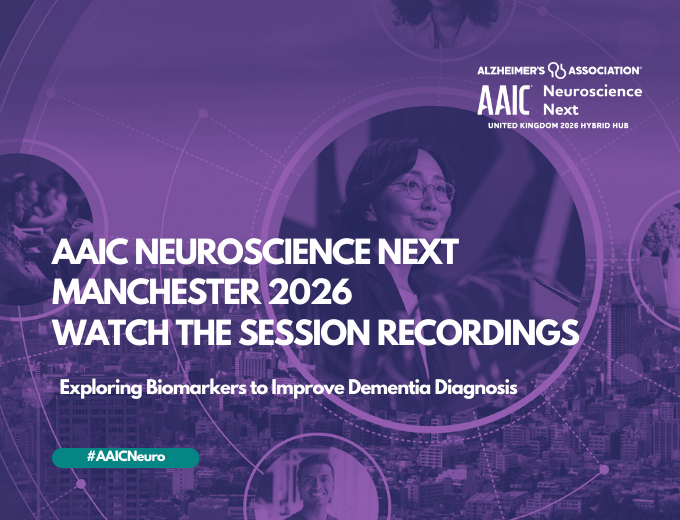
- Thursday 26th February is being delivered in person and online from the hub in Manchester, UK
For those attending the Manchester, UK hub in person, the full-day programme will run from 8.30am to 5.00pm. (some, but not all of the in person sessions will be streamed into the AAIC Neuroscience Next online platform).
We encourage everyone to attend the online event, even if you are also planning to attend in person at the UK Manchester Hub or one of the other locations across the world. The online event takes place across all three days, and the UK Manchester Hub will be in person on the 27th February (hubs at other locations across the world run on other days, details can be found on the AAIC Neuroscience next website).
To attend either in person, online or both, you will first need to register to attend online via the AAIC Neuroscience Next website. Once you complete your registration to attend online, you will recieve an email to direct you to a seperate booking page to attend in person.
This conference is aimed at researchers, clinicians and experts working within dementia and neuroscience research.
The conference has been scheduled to align with the Alzheimer's Research UK Conference which is taking place in Manchester on the 24th and 25th February. We highly recommend making the most of your visit to Manchester and attend both events.
AAIC Neuroscience Next is a global, no-cost hybrid conference that aims to support and showcase the next generation of Alzheimer’s and dementia researchers and clinicians.
King's House Conference Centre, Manchester, M1 7HB
You can find a map, directions, details on transport links and parking at https://www.kingshouse.co.uk/directions
The nearest train station is Manchester Picadilly (18 minute walk)
King's House is close to major bus routes on Oxford Road, and close to tram and train stations.
- Approximately 8-minute walk from Oxford Road train station
- Approximately 12-minute walk from St Peter’s Square Metrolink stop
- Approximately 14-minute walk from Manchester Piccadilly train station
Oxford Road is a main bus corridor into the city centre. The closest Oxford Road bus stops to King’s House are these: the Aquatics Centre (heading South away from the city centre) and All Saints’ Park (heading North towards the city centre).Routes from Piccadilly Gardens, via Oxford Road: 15 & 253 to Flixton. 16, 41 & 263 to Altrincham. 42 & 142 to East Didsbury. 42 & 42A to Stockport and Reddish. 43 & 44 to Manchester Airport. 48 to Northenden. 85 & 86 to Chorlton. 111 & 143 to West Didsbury. 145 to Cheadle Hulme. 157 & X57 to Woodford. 250 & 291 to the Trafford Centre. Routes from Albert Square, via Oxford Road: 191 & 197 to Stockport. Routes from Piccadilly Gardens, via Higher Cambridge Street: 99 to Sale. 101, 104 & 109 to Wythenshawe.
Further Information about public transport in Greater Manchester, including a journey planner, can be found at tfgm.com
Recommended car parks:
1. NCP Circle Square Princess Street, M1 7DN - 3 minute walk, multi-storey. Open 24 hours. Card payment or NCP ParkPass App.
2. MCC/APCOA Aquatics Centre Booth Street East, M13 9SS - 6 minute walk, multi-storey. Open 6am to Midnight. Card payment or APCOA Connect App.
Tips
Please be aware that there are bus gates on Oxford Road. This means that parts of the road are only open to buses, black cabs and pedal cycles from 6am to 9pm every day. If you enter a bus lane or use a bus gate, you may get a Penalty Charge Notice (PCN).
Full postal address: King's House Conference Centre, King's Church, Sidney Street, Manchester, M1 7HE
Students and early career investigators are invited to spotlight their research at AAIC Neuroscience Next.
Undergraduate and graduate students, postdoctoral researchers, assistant professors and research professionals within seven years of graduation of their last degree were eligible to submit abstracts.
Abstracts spanning the breadth of neuroscience research were eligible for submission (not solely those related to Alzheimer’s and dementia research).
Areas of interest include:
- Basic science and pathogenesis.
- Biomarkers.
- Clinical manifestations.
- Drug development.
- Public health.
- Dementia care.
The UK hub is theming its in-person event around biomarkers, with opportunities for presenters to share posters, lightning talks, and short plenary talks in the following areas:
- Fluid Biomarkers
- Cognitive Assessments
- Physiological and Behavioural Biomarkers
- Neuroimaging
- Technology Biomarkers
NOW CLOSED
- Presentations should be prepared using the official event slide template (keep only one of the template slides relating to photopgrahy depending on your preference).
- Slides must be in landscape format.
- The title slide should include the talk title and speaker name exactly as stated in the submitted abstract.
- Text, figures, and graphics should be clear and legible when projected in a large lecture space. Avoid small fonts and dense slides.
- Speakers are encouraged to use high contrast colours and simple layouts to support readability.
- Presentations should be emailed to dementiaresearcher@ucl.ac.uk by Thursday 19th February.
- Technical staff will be available to provide support.
Download the Template
• Posters must be in portrait orientation.
• The recommended poster size is 90 cm wide by 120 cm tall.
• The top section of the poster should include the title and author names exactly as stated in the submitted abstract.
• All text, figures, and illustrations should be large and bold enough to be easily read from a distance of two metres.
• Double sided tape, tacks, and basic mounting equipment will be provided.
• Staff will be available in the poster area to assist with setup.
Download visual guide
The online content will be available to watch back for 30 days after the event ends via the AAIC Neuroscience Next online platform.
A selection of sessions from the UK event can be found at https://www.youtube.com/playlist?list=PLeUI1GHB4EvT9R3qqqvkmW-QVIWiK3t3O
The online event will include live captioning. The UK Manchester Hub can provide sign language interpretation if requested during registration.
It is our intent for the conference to be as accessible as possible.
For the UK Manchester Hub, if anyone requires any assistance other than that listed below, this will be readily given.
Accessible Parking
Sidney Street has seven accessible parking bays, the closest two being just in front of the building.
The closest multi-storey car park, NCP Chester Street, is about 400 metres from the main entrance and has 11 accessible spaces. Further parking details can be found on the King’s House Map and Directions page.
Entrance Doors
There are no steps at the entrance: and the venue has level access from the pavement.
The main entrance consists of double glass doors in the centre, with a single glass door either side. When the doors are unlocked, access would be mainly via the centre doors. When the doors are electrically locked, there is an intercom button on the wall. The doors are then unlocked remotely from the reception desk. Anyone needing assistance opening the door would receive physical help from a member of staff. Once inside the entrance doors there is a one in twelve gradient up into the Foyer.
Exit Doors
The front entrance glass doors have an egress button and emergency break-glass for use when the doors are electrically locked. One fire exit door has a standard panic push pad. All other fire exit doors have standard panic push bars. One fire exit doorway has a small step and another leads to a shared ascending staircase before leaving the shared space and descending.
Circulation
All doors to corridors and meeting rooms have high and low-level vision panels fitted. Most doors are beech in colour with colour-contrasting black door furniture and stainless steel kickplates. All stair nosings are colour-contrasting to the adjacent floor coverings. There is a personnel lift, complete with voice synthesiser, tactile signage, half-height mirror and low-level controls.
Lighting
All meeting rooms are fitted with daylight fluorescent tubes or LED lighting, and have natural daylight. All corridors, meeting rooms, staircases and most toilets are fitted with emergency lighting that activates in the event of a power failure.
Toilets
There is an accessible toilet on the ground floor with an emergency alarm. There is another one on the first floor, accessed by a RADAR key, with unisex shower and an emergency alarm.
Induction Loop Systems
The Auditorium, First Floor Hall and Seminar Rooms 1, 3/4 and 5 have induction loop systems installed. There is also a portable induction loop listener.
Internal Signage
Most internal signage consists of black text on a white background.
Ramps
Access to Decking 1 in the Auditorium is by 2 fixed ramps. We have portable ramps to allow access onto the stage and Decking 2 in the Auditorium.
Babies and children are welcome to the UK Manchester Hub; however, please be aware that the conference programme is designed for an adult audience. We do not provide childcare facilities, but you are welcome to bring your baby or child if this helps you attend. If you need a quiet space for feeding, resting, or changing, please speak to the event team who will be happy to assist - a dedicated place is available.
Yes, UK Manchester Hub venue will have designated quiet spaces available for anyone who needs a break. A prayer room will also be provided. Please ask the event team on arrival for directions.
Recording, photographing, or reproducing any talks, posters, slides, or data at AAIC Neuroscience Next 2026 Manchester UK hub is prohibited without the presenting author’s explicit permission or prior consent. If permission is granted, participants should act with courtesy and avoid disruption. Sharing personal experiences on social media is encouraged, but posting images containing research data is not allowed unless the presenter permits it. Breaches of this policy may result in penalties. Read the full policy.
Companies interested in sponsoring the full event can contact Alzheimer's Association - Jennifer Lombardo, Senior Director of Corporate Initiatives jelombardo@alz.org.
Companies and organisations interested in sponsoring the UK Hub can contact - Adam Smith, Programme Director, Dementia Researcher adam.smith@ucl.ac.uk
If you have a question about the global event email: AAICnn@alz.org
If you have a question about the UK Manchester hub email: dementiaresearcher@ucl.ac.uk
Registration for the welcome reception closed on Friday 13th February.
It starts at 7.30pm on Wednesday 25th February, and is taking place at the Double Tree Hilton, One Piccadilly Place, 1 Auburn St, Manchester M1 3DG

 Dementia Researcher